Love Your City Scorecard Theory
Effective Date
This scorecard theory is effective for reporting organizations on or after October 6, 2025
Responsibility
The Love Your City (LYC) scorecard is issued by LifeCity in partnership with New Orleans’ Regional Sustainability Committee (RSC). Any feedback about the LYC Scorecard can be submitted to impact@mylifecity.com.
Due Process
The LYC scorecard was developed using a multi-stakeholder approach, considering the expertise of community leaders in New Orleans, LA, subject matter experts, and scientists, with regard to globally recognized sustainability responsibilities and goals.
Legal Liability
The LYC Scorecard, designed to promote sustainability reporting, has been developed by LifeCity in partnership with the Regional Sustainability Committee (RSC), through a multi-stakeholder consultative process. While LifeCity and the Regional Sustainability Committee (RSC) encourage the use of the LYC Scorecard and related Interpretations by all organizations, the preparation and publication of reports based fully or partially on the LYC Scorecard and related Interpretations are the full responsibility of those producing them. Neither LifeCity nor the LYC Regional Sustainability Committee (RSC) can assume responsibility for any consequences or damages resulting directly or indirectly from the use of the LYC Scorecard and related Interpretations in the preparation of reports, or the use of reports based on the LYC Scorecard and related Interpretations.
Copyright and Trademark
This document and the LYC Scorecard are copyright-protected by LifeCity. The reproduction and distribution of this document for information and/or use in preparing a sustainability report is permitted without prior permission from LYC. However, neither this document nor any extract from it may be reproduced, stored, translated, or transferred in any form or by any means (electronic, mechanical, photocopied, recorded, or otherwise) for any other purpose without prior written permission from LYC.
LifeCity, Love Your City, LYC, and logo, RSC and logo, and Love Your City Sustainability Scorecard (LYC Scorecard) and logo are trademarks of LifeCity, L3C.
© 2025 Love Your City. All rights reserved.
Purpose and Concept of the LYC Scorecard
Whether intentional or not, organizations have an impact on the environment, community, and economy with which they interact. It is recognition of this and subsequent action that can help determine whether this impact is positive or negative. The objective of the LYC Scorecard is to support organizations in their efforts to become more sustainable—having more positive impacts than negative ones—and be more transparent in their operational practices. LifeCity defines sustainability as meeting the needs of the present without compromising the ability of future generations to meet their own needs.
The uniqueness of the LYC Scorecard is its foundation of place-based sustainability. The LYC Scorecard is a reflection of the immediate needs of the city of New Orleans and surrounding areas, as identified by the Regional Sustainability Committee (RSC), aligned with globally recognized sustainability topics, and translated into actionable steps that organizations can take to become more sustainable. It allows organizations to assess their contributions to building a more sustainable community and disclose the actions they take to reduce negative impacts.
LYC Scorecard System
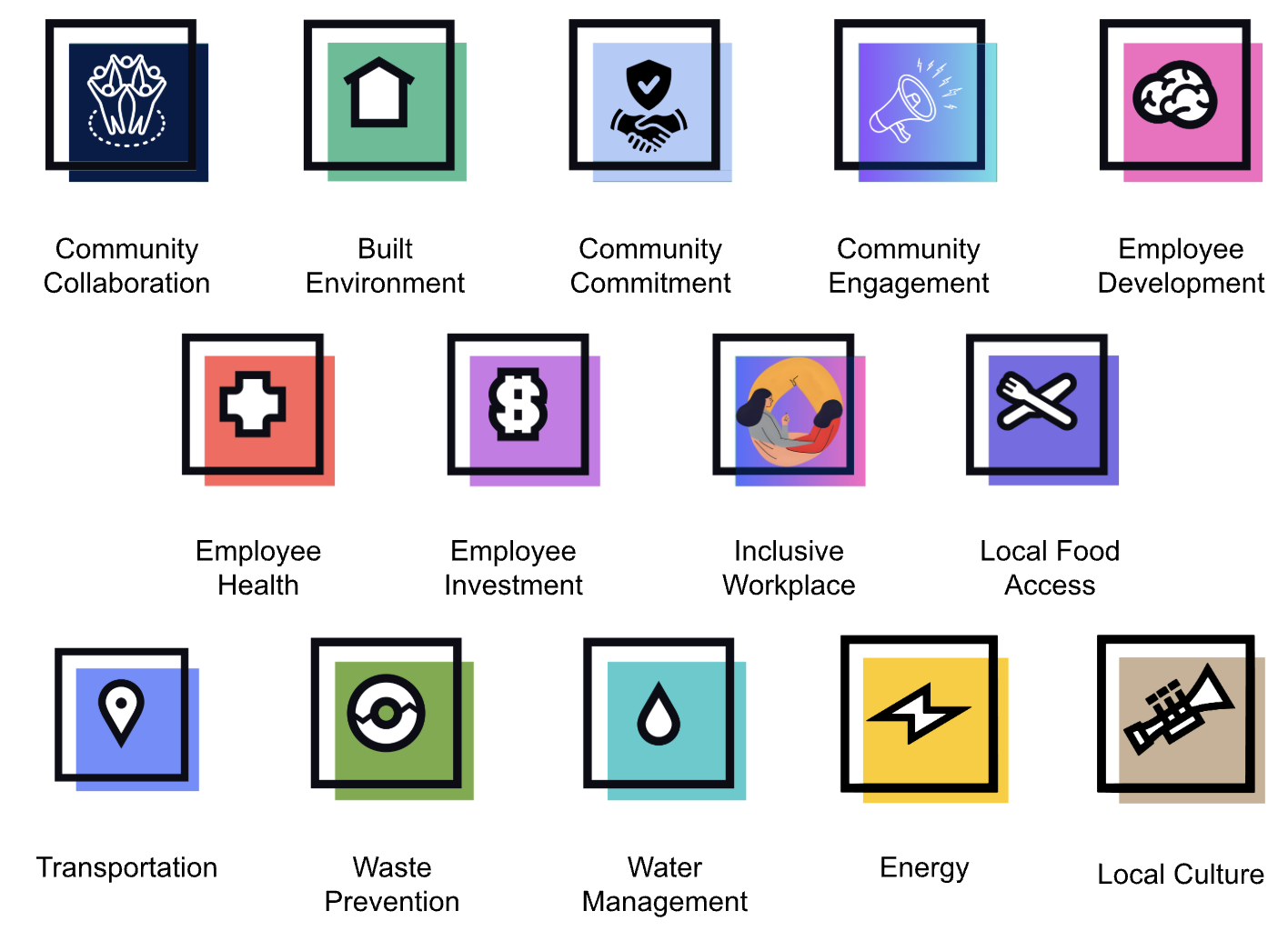
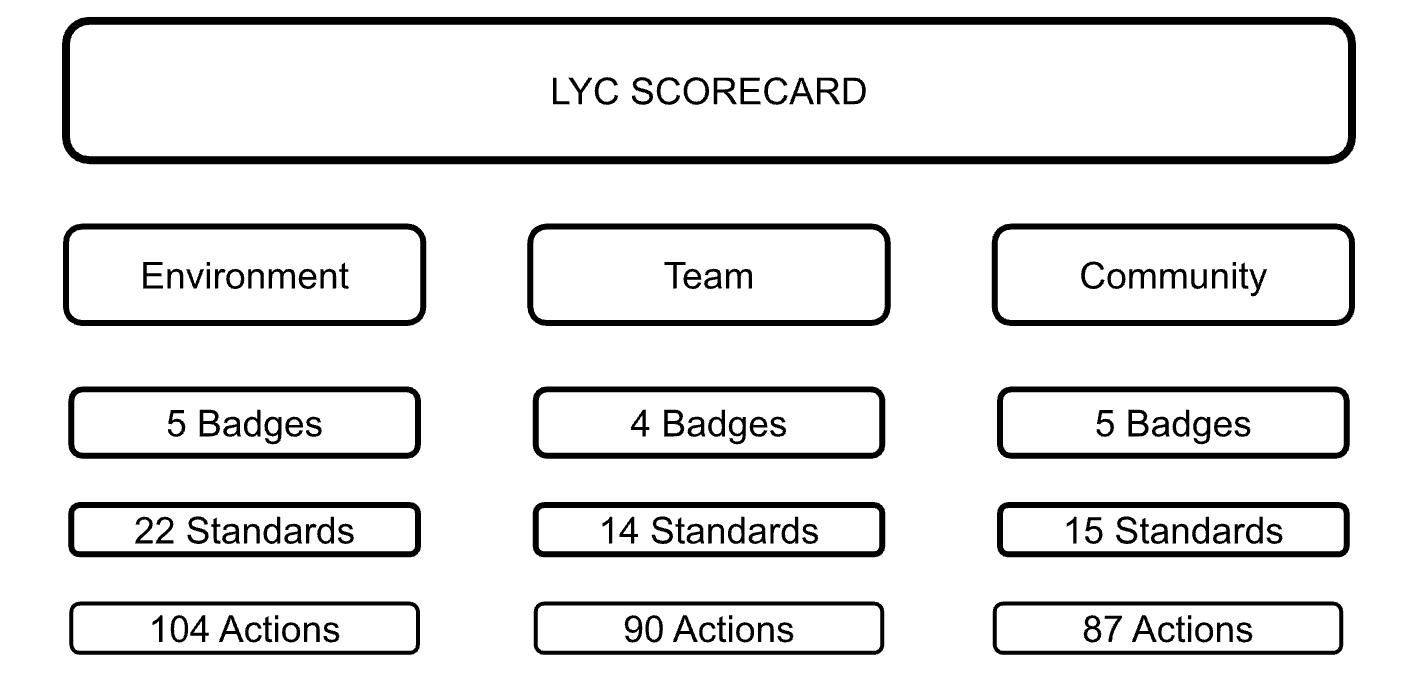
The LYC Scorecard is organized into three impact areas: Environment, Team, and Community, which are defined below. Within these impact areas are badges, earnable by meeting standards, achieved by completing defined actions.
Environment: Topics related directly or indirectly to an organization's impact on the natural environment.
Team: Topics related directly or indirectly to an organization’s employees.
Community: Topics related directly to or indirectly to an organization’s surrounding community.
Badges
Structure
Scoring
Participating organizations are scored based on points earned by completing actions. Actions are scored based on five stages of organizational impact integration:
Stage 1: Commitment to impact integration
Stage 2: Initial Action towards impact integration
Stage 3: Transformation to fully integrate impact into operations
Stage 4: Leadership in impact integration
Stage 5: Systemic Change in helping others realize impact integration

Action items that reflect Stage 1 of impact integration will receive 1 point, while actions reflecting full integration of impact into operations will get 3 points, etc. Below is a description of all five stages:
Stage 1: Commitment (Awareness & Intent)
“We recognize sustainability matters and are exploring what it means for us.”
Organization acknowledges social/environmental challenges relevant to its sector.
Leadership expresses commitment; sustainability is a topic of conversation.
Conducts initial assessments or audits to understand baseline impact.
Gathers input from stakeholders (employees, customers) but has no formal plan yet.
Learning-focused: attending workshops, researching best practices.
No or minimal operational changes implemented yet.
Stage 2: Initial Action & Compliance
“We’re taking practical steps to reduce negative impact and comply with basic standards.”
Implements operational improvements with visible environmental or social benefits (e.g., waste reduction, energy efficiency).
Establishes basic policies (e.g., recycling program, ethical sourcing guidelines).
Engages employees in informal sustainability activities; some training provided.
Begins tracking limited metrics (energy usage, volunteer hours).
CSR activities are ad hoc or philanthropic in nature (donations, volunteering).
Sustainability still largely separate from core business strategy.
Stage 3: Transformation (Integration & Systematic Practice)
“Sustainability is embedded in how we run our business and create value.”
Sustainability goals integrated into business strategy and operations.
Formal policies and processes ensure consistent sustainable practices across departments.
Employee training is regular and tied to job roles.
Measures and reports on multiple impact indicators (environmental, social, economic).
Adjusts product/service design and supply chain to enhance positive impact.
Stakeholder engagement is ongoing; partners and clients informed and involved.
Begins innovation to increase sustainability benefits.
Stage 4: Leadership & Collaborative Impact
“We lead by example and collaborate to expand positive impact beyond our business.”
Sustainability fully integrated into purchasing, hiring, operations, product development, and governance.
Business model explicitly designed to maximize positive social and environmental outcomes.
Publicly recognized for leadership in sustainability; shares best practices widely.
Partners strategically with community groups, NGOs, and other businesses to tackle systemic issues.
Invests in innovations and programs that drive impact at scale (e.g., workforce development, circular economy).
Transparent, externally audited impact reporting and continuous improvement.
Stage 5: Legacy & Systems Transformation
“We are catalysts for transformative change, creating scalable impact and inspiring others.”
Sustainability is core to organizational identity and purpose, inseparable from business success.
Drives systemic change through innovation, advocacy, and ecosystem leadership.
Creates platforms, coalitions, or movements to enable wider adoption of sustainable practices.
Inspires and mentors other organizations to follow their model.
Impact measurement is advanced, integrated, and informs adaptive management at a systemic level.
Long-term stewardship mindset that prioritizes resilience, regeneration, and equity.
The total possible points divided by the total completed points in the scorecard result in a rating of 1-5 hearts (1 heart =0-20% score, 2 hearts =20-40% score, 3 hearts= 40-60% score, 4 hearts= 60-80% score, and 5 hearts = 80-100% score).
Users
Any organization in New Orleans, LA, or the surrounding area can use the LYC Scorecard, regardless of size, type, or industry. The scorecard can be used in place of or in support of its impact reporting. It can also be referenced when setting goals or implementing policies or practices.
Stakeholders and investors can reference an organization’s LYC Scorecard to understand how it incorporates sustainability into its operations and initiatives. A stakeholder may be anyone who interacts with the organization, including employees, customers, and neighbors.