
LifeCity Visits Alstom Transportation, Inc.
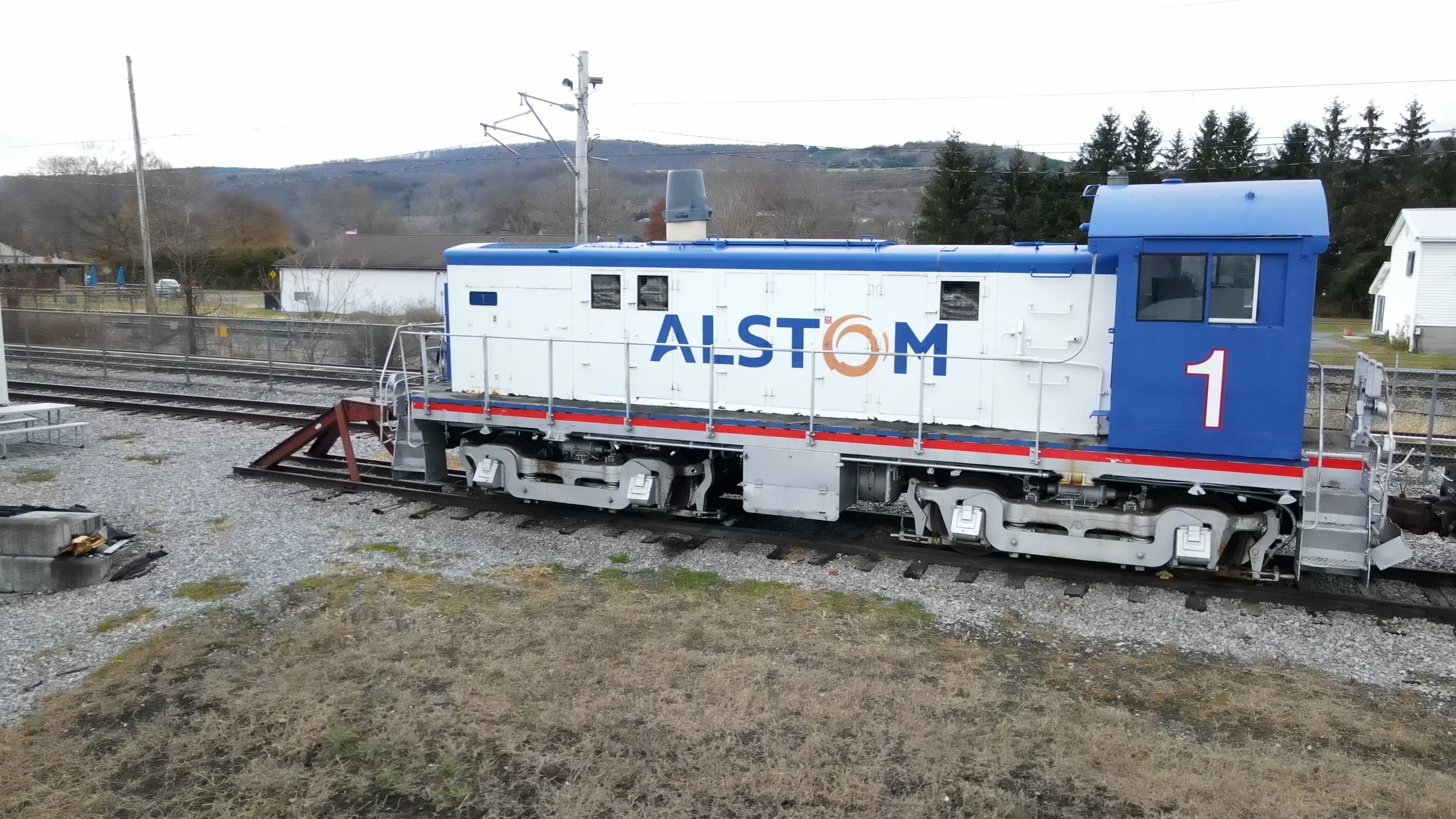
In November 2025, LifeCity visited Alstom Transportation, Inc. to provide impact reporting services for Hampton Roads Ventures (HRV)’s New Markets Tax Credit (NMTC) investment in the company. Alstom is a multinational company based in France that began its US operations in Hornell, NY in 1997. Alstom is a pillar of the local economy, offering quality employment opportunities while celebrating the region’s rich historical roots in the rail industry.
A Railroad Town
Hornell has been a town steeped in the history and economics of the railroad since it became a hub for the Erie rail line in the 1850s. With the increase in freight trucking and the decline of the rail industry in the mid-twentieth century, Hornell experienced economic distress and job loss as rail companies struggled to adapt. The Erie-Lackawanna Rail Shops, formerly a symbol of the vibrancy of the rail industry, fell into disrepair. Alstom revitalized the building and the industry, and has since expanded into the largest employer in the region.
Supporting Local Manufacturing
HRV’s NMTC investment supported construction, equipment, and workforce training for Alstom’s new 135,000 square foot carbody production facility in Hornell. The facility, known as “Plant 4,” is the latest expansion at the company and will support $20M in new projects. The facility is one of the only stainless steel carbody shells manufacturing plants in North America, allowing Alstom to onshore part of its production process that had previously been conducted overseas.
Pat Aini, Carbody Shell Project Director for Alstom, described the business case for the expansion: “To compete in the industry, we recognized the fact that we needed to localize some of our major components, carbody shells one of those – and to be able to meet the Buy America requirements and to be able to better control the supply chain flow from the car shell all the way through to the fitting and final delivery to our customer.” While Buy America requirements for the industry mandate 70% of components to be produced domestically, Alstom aims for a 95% rate.
Creating Career Pathways
Alstom’s Plant 4 expansion will create numerous impacts that will support the local economy and community. The project created 52 quality, temporary full-time equivalent (FTE) jobs during the construction phase, all paying a living wage, with most (85%) being accessible to LIC residents and low-income persons. Additionally, the project has created 214 FTEs to date and ultimately is projected to generate 258 new FTEs. As of year end 2024, the total employment at Alstom is 639, all of which are quality jobs.
Importantly, nearly all (85%) permanent FTEs at Alstom are accessible to LIC residents and low-income persons, meaning that individuals who have historically lacked access to quality jobs will have the opportunity to gain a career pathway at Alstom which will lead to a stronger local economy. Over half of Alstom employees have less than a 4-year college degree. Alstom has numerous career training pathways and opportunities forall advancement, both in-house through its Automation Academy, and externally through partnerships with Alfred State College and GST BOCES. Dr. Craig Clark, Executive Director of the Allegany County Industrial Development Agency and Former Vice President for Economic Development at Alfred State University, described Alstom’s workforce development process as “training the skilled workforce from people who only had a high school education to be able to move up the workforce in various ways. I think that’s really important because that gets people out of poverty and into good jobs.”
Catalyzing Economic Development
Given Alstom’s size relative to the community, expansions at the company have major downstream economic impacts. Local leaders credit Alstom’s growth as the catalyst for a variety of community improvement projects. According to Hornell Mayor John Buckley, the community has added nearly 300 housing units in the last decade, largely to accommodate the increased employment at Alstom. The community has new amenities including a brand new YMCA and a state-of-the-art hospital, which Mike Nesbit, Executive Director of the City of Hornell IDA said would not have been approved for funding by the state without Alstom’s expansion. Alstom’s international business operations require individuals to travel to Hornell from around the world, and now the town has a business class hotel as a result. Additionally, Alstom emphasizes the local supply chain by working with around 300 local subcontractors. This local investment, along with the jobs created, has a major economic impact, according to Dr. Clark, who said that every dollar spent in the community can have a multiplier effect of three to four times.
LifeCity’s impact reporting process allows clients like HRV to acquire third-party validation for the impact of their investments, promoting the efficacy of these investments and benefiting future NMTC applications. Alstom’s expansion in Hornell will continue to increase the company’s impact on the town both in terms of employment and economic development. Alstom represents a committed community partner whose growth in Hornell continues to be transformational for the region.